
History of Polish food and cuisine — Old Polish traditions
Polish cuisine from the Middle Ages to the 19th century
The Polish cuisine in the Middle Ages was based on dishes made of agricultural produce (millet, rye, wheat), meats of wild and farm animals and fruits, herbs and local spices. It was known above all from abundant salt using and permanent presence of groats. A high calorific value of dishes and drinking the beer as a basic drink (unlike the wine spread in south and west Europe) was typical of Middle Ages Polish cuisine. A beer and a mead were most popular drink for a lot of time, but with time an expensive wine, imported mainly from Silesia and Hungary appeared.
Medieval chronicles describe Polish cuisine as very pungent, using large amounts of the meat and groats. Indeed, medieval Polish cuisine applied prodigious seasonings amounts (when compared with other countries of Europe), mainly pepper, nutmeg and juniper. Thanks to close trade relations between Poland and countries of the Orient, prices of spices were lower in Poland than in many other countries. Up to today's times mentions of aromatic, dense and very spicy Polish sauces behaved ('jucha szara' and 'jucha czerwona', nowadays unknown). Apart from that balm, the turnip and pea were common. What's interesting in the Middle Ages a flatware wasn't used at all.
The oldest written sources
'Compendium Ferculorum albo zebranie potraw' by Stanislav Czerniecki is the oldest Polish cookbook. The book dates from 1682. Only a century later in 1786 a next great work of this type was published – oeuvre of Wojciech Wieladko 'Excellent Cook' ('Kucharz doskonaly' in original), a book unusually popular and repeatedly resumed. What's interesting reprints of this book are also available in Poland nowadays – but rather as the certain curiosity or position for fiends.
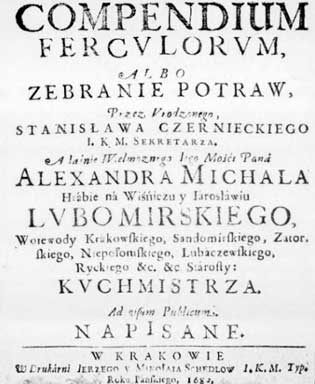
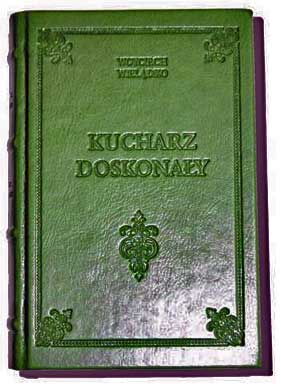
and 'Kucharz doskonaly' ('Excellent Cook') from 1786.
A little bit later in the end of 18th century Jan Szyttler, disciple of the famous royal chef Paul Tremon, became an author of first, systematic cookbooks on Polish land.
Influence of geographical and political factors on the Polish cuisine
Geographical and political factors had a strong influence on Polish cuisine. The country is located in a climatic zone with cool and barren winters. From that reason in traditional Polish meals vegetables, fruits and fish which can be easily preserved and stored for 3–4 months period played the great role (pea, the broad bean, kohlrabi, or the turnip). The food was preserved above all with readily available fossil salt and usually with drying, pickling or slight fermentation. After implementation of cooling and tinned technologies in the 20th century salting, drying and pickling were kept in the Polish cuisine by the account of historic habits and from the will of keeping traditional tastes – impossible to obtain with those new, technological ways.
Other geographical facet – large areas of forests – had to influence Polish diet and recipes. Sylvan fruits (wild strawberries, blueberries, currants, raspberries, wild black raspberries and others) have always been popular and so they are today. The Polish cuisine has an interesting wild mushrooms table d'hôte. It seems to be unique since wild, edible mushrooms are completely undervalued in Western Europe. On the other hand the game constituted a delicacy for the Polish gentry from always. Today however, the tradition of hunts seems to be in the disappearance.
Poland repeatedly in history lost the access it the Baltic Sea because of wars. For this reason the Polish cuisine is dominated by freshwater fishes. Amongst saltwater fishes once herring enjoyed the greatest popularity. Today – beside herring – fish like codfish, dory pollack, sprat and sole play the special role on the Polish table.
Until the partitions of Poland, the country was one of the biggest countries in Europe. As a consequence some features of cuisines of other nations – living within the limits of Polish Republic those times – permeated to Polish cuisine. Therefore many Poles say that their national cooking is a blend of influences – besides own ideas, over the centuries polish cuisine collected what best at the culinary tradition of neighboring countries and nations. Historical period of partition of Poland, which lasted 123 years, also affected the shape of some Polish dishes and introduced some new ones – coming from German and Austro-Hungarian cousines.
Influence of fasts
Implementing the Christianity in Poland in year 996 had a significant influence on the diet. Fasts were extorted both through the clergy, as well as the secular authority. An example is King Boleslaw I the Brave (967-1025) who ordered to knock out teeth of those, who didn't refrain oneself from eating the meat in fast days. Customs in the Middle Ages were much more restrictive than in our times indeed. Eating not only meats, but also eggs and dairy products was forbidden. Was it a big problem? we ask ourselves. Well, the bad news is that the Lent all the way to 1248 yr lasted as many as nine weeks in Poland! Fast restrictions were in effect also on Fridays, holidays eves and additionally three times for the quarter in so-called 'dry days'. Nowadays the tradition of the fast is cultivated ruthlessly into the Christmas Eve, and in some Polish families also on Fridays. Watching the situation from the historicacl perspective - the Roman Catholic Church by enforcing fasts is responsible for spreading of eating fish and rising vegetarian traditional dishes. Many other dishes are found in two tins: normal meat and meatless. All that with the unquestionable benefit to the health.
Custom of revelling
Feasts have usually been connected with holidays, family celebrations or entertaining respected guests. They were extremely lavish in case of monarchal manor houses, peculiarly when the feast had a political clout. According to chronicler Jan Dlugosz number of dishes on the table of King Jagiello reached one hundred during exceptionally grand feasts. Oftentimes stories of storytellers, singing and music accompanied feasts. Less impressively magnates, as well as a burgesses or peasants revelled.
During feasts a tableware was an important attribute. Even on prince's manor houses they usually used clay and wooden dishes. For a special feasts a tin, silver or gold tableware was kept. With time such exclusive tableware appeared also among lower social layers, of what bourgeois wills from the 15th century are an evidence. Not excessively wealthy people were in possession of silver mugs and spoons, tin plates, or decorative bowlfuls. Embroidered tablecloths were present from time to time even in homes of peasants.
Old Polish cuisine – tastes and ingredients
The Old Polish cuisine – the oldest and most traditional one – specializes in mealy and cereal dishes (dumplings, kasha, pierogi), products of sylvan fleece (mushrooms, fruits, herbs), pork (including cold cooked meats and sausages), freshwater fishes, game, baking (bread, cakes), desserts, vodka and fruit liqueurs. Many kinds of soup and stock made from local vegetables, fruits, cereal crops and meat products are typical of the Polish cuisine.
Spices typical for polish food are horseradish, dill, juniper, pepper, sour cream, curd cheese. Among vegetables and fruits: beetroots, cucumbers, cabbage, apples, cherries, blueberries, gooseberry and other Central–European are typical, and in history also wild plants like the sorrel, young beet green, dandelions or stinging nettles.
Vegetables with high nutritional value, which can be stored during winter, play the great role (pea, the broad bean, kohlrabi, or the turnip). Sometimes in the winter period food was enriched with nuts, while forage for farm animals with acorns. Typical fruits in the Polish cuisine these are apples and fruits of the forest, as well as plums, pears, morello cherries, unknown in the Northern Europe cherries, gooseberry and currants. Poles use these fruits up till today in dishes, desserts, baking, fruit liqueurs as well as compotes, specific plum jam and preserves.
Relating to the kitchen of other countries - cereal dishes - groats, breads and diverse mealy dishes – pierogi, dumplings, soup and sauces – are typical of the Polish cuisine and other West Slavonic nations. Poland is not an exclusively agricultural country but also profusely forested (even today about 25% of Polish territory is a forest). Hence Old as well as modern Polish cuisine offers a lot of delicious meals made of sylvan fleece (mushrooms, wild fruits, nuts and herbs).
In history choice of the meat in the polish cuisine also depended on the forestation. In contrast with other countries like France or Hungary, in medieval Poland forests were not being cut down to convert the land into pastures. Neither Poles grazed cattle on a great scale. Farm animals has been rather kept in corrals as a source of dairy products above all valued.
Pork was peculiary popular meat in Poland. Pigs were grazed in forests and people willingly took advantage of the wild sylvan game, as a source of meat too. Therefore the meats typical of the Old Polish cuisine are dishes of the pork, the poultry and the various game – from rabbit or birds to roe deer or wild boars.
Little requiring poultry was bred in corrals for nutritious and nourishing eggs, as well as for the readily available meat in the case of any fowl population surplus. Poles come economically up to the cattle earmarked for slaughter. Whole animal was used, including giblets and blood, from which the black pudding (kaszanka) and bloody soup (czernina) were made, what as the culinary curiosum was known in the whole Europe. To this day the black pudding remains popular, however czernina is not being eaten already.
Since always rivers provided freshwater fishes. Poland in history lost and again regained the access to the sea few times. Therefore freshwater fishes, caught alive from lakes, creeks, ponds and rivers, as well as crayfish (unknown in the west and comparable to foreign lobsters) dominate in the Polish cuisine. However also saltwater fishes were known, from which for years herring was the most popular. Herring is simple to preserve with salt and therefore could be transported to places far from the seaside. A perishable seafood, as oysters or shrimp, wasn't used in the Polish cuisine, nor a caviar was eaten (contrary to Russian cuisine which has access to sturgeon).
Typical tastes of Old Polish cuisine it salty, lightly fermented or marinated (e.g. dill pickles, cabbage, sour milk, kvass), as well as moderately pungent (the horseradish, the mustard, chives, onion, garlic and the overseas pepper), spicy and herbal (juniper, overseas nutmeg, anise, caraway), slightly tart (the sour cream, the cabbage and dill pickles) and sour–sweet (got typically with apples, cranberries or other fruits added to food). Widely applied and typical spices in Polish and Slavic kitchen are a dill and a poppy, and once also a flaxseed.
Pungent and spicy tastes are usually relieved and supplemented with the cream. In Polish cuisine reducing or emulsifying sauces and fats with vinegar, wine or other alcohol is relatively little–known. Reduction of fats and reviving tastes of fatty dishes is usually received through the addition of the sour cream, slightly tart fruits or marinated vegetables whether moderately pungent onion, horseradish, garlic or the mustard. The popularity of vinegar is lower than in other countries, although it is most important and universally used element of all pickles. Vinegars aren't produced on the basis of the sour wine like in kitchens of countries knowing the grape harvest. The beer in the Polish cuisine was in past used as the nourishing base of soups (so-called 'polewki'), while vodka and fruit liqueurs were always drank independently as alcoholic beverages.
New Polish cuisine and its regional diversity
The contemporary Polish cuisine replaced groats being the staple in history with potatoes, while game dishes are replaced today with the pork and the farm poultry. Tomatoes won the great popularity also. Also eating easily available meat increased, while eating giblets reduced. Producing cheap sugar from beet readily drove and replaced honey in baking and desserts.
Similarly as in other national kitchens, certain regional specializations appear also in Polish cuisine. Saltwater fishes are popular particularly on the Polish coast of Baltic Sea today, sheep's dairy products in the mountains, whereas freshwater fishes in the Land of Great Mazurian Lakes. In times of wars and loss of the independence differences deepened, and regional cuisines adopted some meals from the cuisines of three occupying nations.
Polish regions have unique menus, but to some extent only. List of regional foods is not so long, and most traditional dishes are considered national. For example chicken broth is associated with Silesia as typical food, and for the main course meat with dumpling. On the other hand tripe and pork chop with cabbage and potatoes could be served in Mazovia. In Greater Poland German-Polish dishes are liked (ajntop; meat jelly known as the aspic or 'cold legs'; myrdyrda), whether in Lublin dumplings with the buckwheat groats and the curd cheese are number one. Apart from some of such regional food, main dishes of modern and Old Polish cuisine are universally known and consumed throughout the country.
The dinner in Poland is usually had about 2 p.m. It consists of three dishes. Soup constitutes the first dish. In keeping with tradition on Sunday a chicken stock (broth) is typical given. Main course is a meat dish usually (or fish at Fridays), e.g. pork cutlet ('kotlet schabowy') which is served with boiled potatoes (in chunks or crushed on puree) and with vegetable 'sorowka' (shredded root vegetables with lemon and the mayonnaise or cream). To be a little bit more traditional replace potatoes with groats. During the Polish dinner a dessert consists of a cake as a third dish. It might be for example the poppy-seed cake, the cheesecake or the yeast cake with fruits. In the majority of families compote or juice fruit is served during main course.