Kielbasa — Polish sausages
Polish sausage, better known as kielbasa (kiełbasa in original) is and has always been present on the table in Polish households. Whether it is Christmas or a regular weekday, whether they are at home or work, kielbasa can be eaten heated or cold, in a sandwich, in soups or sauces, with scrambled eggs or vegetables. Polish sausage is a highly appreciated camping food ;) well-done in a campfire or grill. It is regularly served in Polish restaurants. Fat, dry or slightly dried, smoked, cooked, hard and raw, natural or with some chemical additives.
Polish sausage varieties - dry kielbasa, normal & smoked
Most of kielbasa varieties in Poland are one of the two basic types: normal sausage or dried. Dry kielbasa (sucha) has the advantage of lasting longer, while it still retains its full flavor. Usually dry kielbasa is consumed cold, while the regular one can be eaten both cold and cooked or fried. Also normal kielbasa is favored to use in traditional Polish dishes such as bigos. Of course there are also some other types of kielbasa (Polish cuisine knows more than a dozen varieties). Among these, smoked kielbasa is especially appreciated, while biala kielbasa is always served with traditional zurek / zur soup.
Traditional Polish kielbasa is made of pork
Most of Polish sausage types are based on pork meat, although in some areas we have got beef kielbasa available, and sometimes even turkey or lamb. These have, however, minor significance but it is worthwhile to know that each region has its own specialty (read our 'Regional Polish food - diversity of Polish food traditions' article). Nevertheless, the most popular varieties of Polish sausage are called: kabanosy, krakowska, wiejska and mysliwska. So now let's check what all those names mean!
Kabanosy - fine, dry Polish sausage
Kabanosy are a fine variety of Polish sausage that is air dried and flavored with caraway seeds. Often seasoned only with black pepper. Originally, a long time ago, kabanosy were being made from horsemeat, but (fortunately) today it's only a matter of history and kabanosy are pork sausages (sometimes turkey). The name comes from a word 'kaban' which meant pig, a male pig to be more accurate.
I love well made kabanosy, it is one of my favorite types of kielbasa. That's how my breakfast looks from time to time:
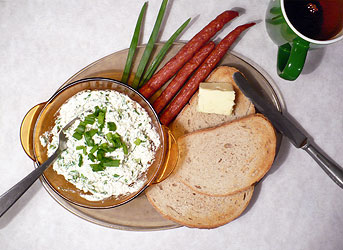
Polish sausages of the kabanosy type are dried, have a 'dry texture' and most often a bit of smoke in the taste. This kielbasa is quite long - usually 12-24 in, and very fine - with a diameter of about 1 cm (0.39 in). Theelicious taste and unique look of kabanosy are the most important & characteristic features of this Polish sausage. Kabanos is most often eaten cold, as an appetizer.
Kielbasa Krakowska - sausage from Krakow
Krakowska sausage is one of the most popular Polish sausages known throughout the world - one of the best in taste and quality. It is a permanent, roasted sausage, the recipe for which comes originally from the sixteenth century and… obviously from Krakow. If kabanos is smaller than the typical Polish sausage, Krakowska is larger (3-4 in diameter), straight and almost always consumed in slices as an addition to salads, sandwiches etc. As such Krakowska is eaten cold, but you can cook it, too. It depends on personal preferences and taste.
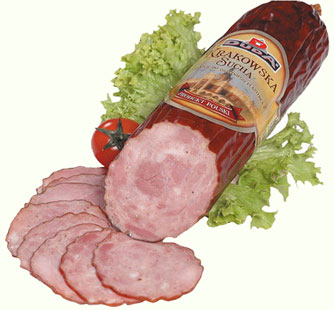
"Krakowska is a type of Polish sausage (kielbasa), usually served as a cold cut. (…) It is made from cuts of lean pork, seasoned with pepper, allspice, coriander, and garlic, packed into large casings, and smoked. In the English speaking countries it is often called after the German translation of the masculine noun for an inhabitant of Krakow: Krakauer sausage" – Wikipedia
Kielbasa Wiejska
Wiejska is a kielbasa in a 'U' shape. Wiejska is made of pork and veal meat, contains marjoram and garlic. Its name means 'countryside-like' from Polish 'wies'. To keep its perfect taste, it should be thoroughly smoked as much as is needed, not evens a minute shorter or longer. This Polish sausage is made according to a traditional Polish recipe. The production of Wiejska kielbasa is based only on natural spices (black pepper and garlic) and a small amount of salt. When we cut the sausage we can check its tenderness, see large pieces of pork meat stuffing, supplemented with natural spices – with all these you can expect a great flavor and will want to eat even more of it.
Kielbasa Mysliwska
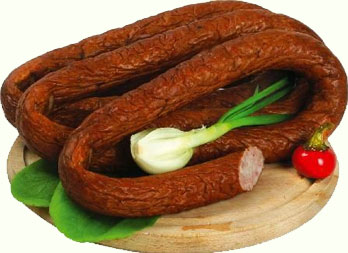
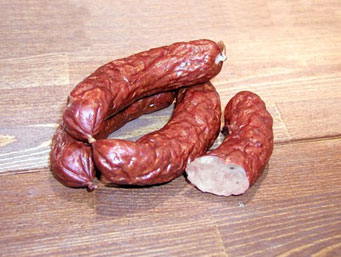
Mysliwska, is a pork sausage also, similar to Wiejska, but it usually has a much better quality. Its name means 'hunter sausage' in Polish. It is a short kielbasa with a dark brown and wrinkled skin. It looks like a curved sickle, and is mostly divided into 'pairs', bars with a length of about 6 in. Dark red chunks of beef and bright red pork pieces are visible in cross section.
Other types of Polish sausages
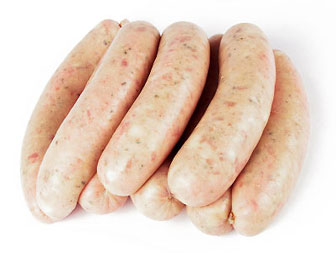
Beside the traditional ones, some pink-red color sausages are also very popular in Polish cuisine. The most characteristic one is a so-called 'white sausage' (biala kielbasa). This kielbasa is made of raw pork & beef, covered with white natural animal intestine. The recipes for biala kielbasa use some natural spices such as garlic, marjoram, black and white pepper and salt. This kielbasa is cooked or fried before consumption, but there are some daredevils who like to eat it raw. It is one of the traditional Polish food served during Easter in the delicious Polish soup called zurek (as I've already mentioned above). And by the way biala sausage – at its own – tastes excellent with horseradish sauce (a very typical Polish combination!).
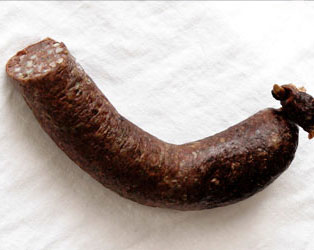
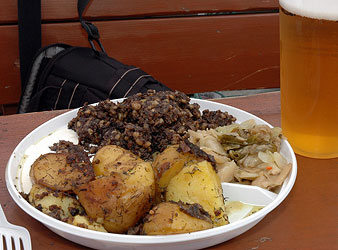
Biala kielbasa is white, so now it is time to check the other side - the black sausage. Actually called kaszanka or kiszka in Polish, it is in fact a blood sausage - as we call it in English. And this is because it's made of a mixture of pig's blood, pig offal (commonly liver, lungs, skin, and fat) and buckwheat (sometimes barley or rice). All of these ingredients are stuffed in a pig intestine. Usually it is flavored with onion, black pepper and marjoram. Home production of this specific kind of kielbasa is mainly based on an occasion of killing a pig, when fresh blood is available. For making bloody kielbasa buckwheat or barley should be used. There is also another kind of this Polish sausage – baked and brewed (cooked after filling). The resulting product resembling kaszanka is called 'bulczanka' where grits are replaced by bread crumbs and kadrel, which consists mainly of blood and pieces of fat bacon. Kaszanka can be eaten cold, but traditionally it is either fried or grilled with some onions and then served with potato and sauerkraut.
Photos by TastingPoland (1) and kingary (2).
As you have seen so far – there are many kinds of sausages in Poland. It is impossible to go to the store and ask for one pound of kielbasa… You would be asked: which kielbasa? All of them look great and appetizing, but it's worth to know some basic differences between all of those kinds. Smacznego!
How to buy good quality kielbasa? - the most important factor
At least in Poland the first thing you should check while buying Polish kielbasa is 'how much meat was used to make 100 g of a given Polish sausage'? This information is obligatory and always placed on the package. Just have a look:
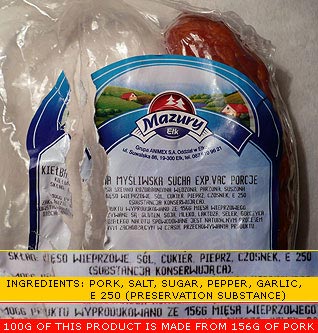
This is kielbasa Mysliwska, sucha (dried). Every 100 g of sausage was made from 156 g of meat! Please note that this means high quality. During the process of drying or smoking of meat it loses weight (the main ingredient – water – simply evaporates). The more meat was used – the better (kielbasa contains less fat and other kinds of additives). Very poor kielbasas with low prizes contain less than 100 g of meat per 100 g of the final product. Don't you even dare trying it! ;) In Poland good quality kielbasa costs about 4-7 $ per pound.
Have look at an advertisement by one of megastores. This kielbasa costs 5,49 PLN per kg (about 0,8 $ per pound!). Bright skin and white-pink (too pink) color betray low content of meat (but high content of fat and other additives like minced animal skin…). They are not even fit to feed dogs.

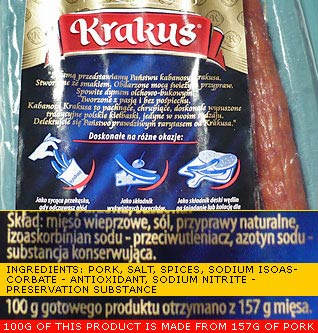
However, another GOOD example are kabanosy by Krakus (made of 157 g of meat per 100 g of final sausage):